Most HVAC contractors do not have a software problem. They have a fragmentation problem.
Your quotations live in one tool. Your job scheduling lives in another. Your service contracts are managed in a spreadsheet. Your engineers update job status via WhatsApp. And your accountant reconciles all of it manually at month end, working from three different exports that never quite agree.
This is not a technology gap. It is a structural one — and no single feature will fix it. Only a complete, integrated system will.
This guide is written for HVAC contractors, service directors, and operations managers who are evaluating business management software and want to understand what it should actually do, what it genuinely costs, and how to choose the platform that will scale with their business rather than hold it back.
What Is HVAC Business Management Software — And What Should It Actually Do?
Defining It in an HVAC Context
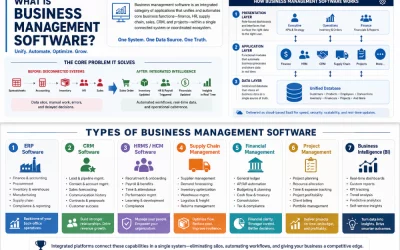
HVAC business management software is an integrated operational platform that connects every function of a heating, ventilation, and air conditioning contracting business — from the first customer enquiry through to asset maintenance, job costing, invoicing, and financial reporting — inside a single system.
The word integrated is doing real work in that definition. A platform is not integrated simply because it has an API connection to your accounting package. Integration means that when a technician closes a job in the field, the labour cost flows automatically to the work order, the sales order, and the profit and loss ledger. No re-entry. No reconciliation. No lag.
How It Differs From Generic Project Management Tools
Generic project management software is built to manage tasks and timelines. It is not built to manage refrigerant batch tracking, SLA response windows, multi-site service contracts, or the relationship between a callout job, a purchase order for a replacement part, and a maintenance invoice billed quarterly in arrears.
HVAC operations have vertical-specific complexity that horizontal software cannot address without painful workarounds. The best HVAC business management software is one that was built to handle that complexity from the ground up — not one that has been stretched to accommodate it after the fact.
The Real Cost of Running an HVAC Business on Disconnected Tools
Contract Revenue Leakage and Missed Service Visits
Every HVAC contractor has a version of this story: a planned maintenance visit that was never scheduled because no one received the reminder, a quarterly invoice that was never raised because the job was marked complete in the field app but never updated in the billing system, a service contract that renewed silently at the wrong rate because the pricing was locked in a spreadsheet last updated eighteen months ago.
This is not human error. It is what happens when the data that drives your revenue lives across systems that cannot communicate reliably. Industry estimates consistently suggest that contract revenue leakage for service businesses operating on disconnected tools runs at between three and seven percent of annual contract value. For a contractor with £2 million in recurring service revenue, that is between £60,000 and £140,000 disappearing quietly every year.
Scheduling Chaos and Compliance Risk
Without a system that links your engineers’ skills and availability to live job requirements, scheduling becomes a daily exercise in improvisation. The wrong engineer gets sent to a complex refrigeration fault. Response time SLAs are missed because there was no visibility of outstanding commitments. Asset maintenance records fall out of compliance because no one tracked when the last service was completed or who signed it off. In order to tackle that issue, you need a reliable software for managing on-call schedules for HVAC business.
In regulated sectors — hospitals, food production, commercial property — incomplete maintenance records are not just an operational embarrassment. They are a contractual and legal liability.
10 Must-Have Features of the Best HVAC Business Management Software
These are the features that separate a genuine HVAC operations platform from a repurposed generic tool. Every one of them should be present — and fully integrated with the rest of the system — before you commit to a platform.
1. Service Contract Management with Multi-Site, Multi-Asset Support.
A single contract must be able to cover multiple customer sites, with each site holding its own asset tree. Contract values must be manageable at both contract level and individual asset level, with billing schedules — annual, quarterly, monthly — running automatically.
2. Asset Management and Equipment Lifecycle Tracking.
Every asset your engineers install, service, or maintain should have a full record: installation date, service history, maintenance schedule, warranty status, associated documents, and a timeline of every action taken against it.
3. Job and Work Order Management with Costing.
Jobs must link directly to sales orders, purchase orders, and inventory. Labour time, materials issued, and subcontractor costs must all flow back to the job automatically, giving you a real-time cost position on every piece of work.
4. Skills-Based Scheduling and Dispatch.
The scheduler must match job requirements to engineer skill sets and availability. If an engineer does not hold the relevant qualification or certification, the system should prevent them from being assigned — not warn you afterward.
5. Field Service Mobile App with Offline Capability.
Engineers in plant rooms and basements need a mobile app that works without reliable signal. Time recording, parts usage, photographs, customer signatures, and satisfaction ratings should all be capturable in the field and synchronised automatically when connectivity is restored.
6. Inventory and Parts Management with Serial and Batch Tracking.
HVAC contractors manage refrigerants, components, and consumables that require full traceability. Lot management, serial number tracking, and quarantine controls are not optional extras — they are compliance requirements.
7. CRM with Full Customer and Site History.
Every customer interaction, quotation, order, job, complaint, and communication should be visible in one timeline. Sales teams and service teams should be working from the same record, not maintaining parallel versions of the truth.
8. Quotation and Estimating with Approval Controls.
Quotations must support multi-currency, template-based formats, custom line item descriptions, and minimum margin controls so that sales staff cannot inadvertently quote below cost.
9. Purchase Orders Linked to Jobs and Projects.
Procurement should flow naturally from operational demand. A purchase order raised against a job should automatically update the job cost. A part ordered for a specific sales order should be traceable from supplier invoice to customer delivery.
10. Integrated Accounting and Custom Reporting Dashboards.
Financial reporting — sales ledger, purchase ledger, nominal ledger, P&L, balance sheet — must sit inside the same platform, not in a separate system connected by a scheduled export. Drill-down from a financial figure to the underlying transaction should take seconds, not a phone call to the accounts team.
What “Complete” Really Means — And Why It Matters for HVAC Contractors
Single Source of Truth vs Data Silos
The most important word in the phrase complete business management software for HVAC contractors is not software. It is complete. A complete system means that every department — sales, operations, procurement, finance — is working from the same live data at the same time.
When your service manager checks a customer record, they can see the open purchase orders. When your accounts team raises an invoice, they can see the job cost breakdown. When your engineer closes a callout, the asset record updates and the billing trigger fires. That is what completeness means in practice.
The Two-Click Test — From Enquiry to Invoice
Here is a useful benchmark when evaluating any platform: how many clicks does it take to move from a new customer enquiry to a raised invoice? On a well-designed system, a user should be no more than two clicks away from starting any key process. If raising a quotation requires navigating through five menus, populating data that already exists elsewhere in the system, and then manually notifying someone in operations, the platform is not complete. It is merely comprehensive.
Role-Based Dashboards Without Vendor Dependency
A complete system gives every user — the service desk, the field engineer, the financial controller, the managing director — a dashboard that surfaces the information most relevant to their role, built without requiring a call to the vendor. Customisable widgets, KPI tiles, job lists, and financial charts should all be configurable by the users themselves.
Best HVAC Project Management Software for Small Business — What Growing Contractors Need
The Named-User Licensing Trap
The named-user licensing model — where you pay a monthly fee for every person who has a login, regardless of whether they are in the system simultaneously — is one of the most effective ways for software vendors to extract revenue from growing businesses.
An HVAC contractor with thirty staff does not have thirty people in their business management system at the same time. They have engineers in the field, supervisors on site, and office staff working staggered shifts. Paying for thirty named licences when only eight users are ever concurrent is not a pricing model. It is a tax on growth.
Why Concurrent Licensing Is the Fair Model for HVAC Teams
Concurrent licensing charges for the number of simultaneous users, not the total number of people with access. This model aligns cost directly with actual system usage — and for HVAC contractors, where operational roles are split between field and office, it routinely delivers a significant cost reduction against named-user alternatives. As your business grows and your headcount increases, your software cost grows only if your simultaneous usage grows. That is how pricing should work.
SaaS vs Perpetual Licensing — What HVAC Business Software Really Costs
Total Cost of Ownership Comparison
SaaS subscription pricing feels accessible at the point of purchase. A monthly per-user fee is easy to budget. What it obscures is the long-term trajectory: subscription costs compound annually, pricing control sits entirely with the vendor, and the fees you pay in year ten bear no resemblance to the fees that made the platform look affordable in year one. Over a ten-year period, a well-priced perpetual licence will typically cost significantly less than an equivalent SaaS subscription — while giving you full ownership and control of your data and infrastructure.
Perpetual Licensing as a Balance-Sheet Asset
A perpetual licence is a capital investment. Unlike a subscription — which is an operating expense that disappears when you stop paying — a perpetual licence appears on your balance sheet as an asset. For businesses managing their financial ratios carefully, or those considering future investment or sale, this distinction matters. Where upfront capital is a concern, perpetual licences can often be financed through a lease or loan, converting a capital purchase into predictable monthly payments while retaining the long-term cost advantage.
How to Choose the Right Business Management Software for HVAC Contractors
Define Your Operational Scope First
Before you speak to a single vendor, document your operational perimeter. How many sites do your service contracts cover? How many assets are under maintenance? How many concurrent users do you realistically need? What are your compliance and traceability requirements? Vendors who do not ask these questions before recommending a platform are selling, not consulting.
Evaluate Integration Depth, Not Feature Count
A platform that lists forty features on its marketing page but runs them as loosely connected modules is not an integrated system. Ask vendors to demonstrate a live workflow — from sales order through job creation, inventory allocation, and purchase order to invoice — without switching systems, re-entering data, or using a third-party tool. If they cannot do it, the integration is not real.
5 Questions to Ask Every Vendor You Demo
- How does a job cost flow back to the originating sales order — automatically or manually?
- Can I see a service contract with a multi-site asset tree and a scheduled maintenance billing run?
- What is your concurrent vs named-user licensing model, and how is concurrent usage calculated?
- Is perpetual licensing available, and what are the self-hosting options?
- What does your implementation and training process look like, and what ongoing support is included as standard?
Why BME Is Built for HVAC Contractors
Business Manager Enterprise (BME) was developed over thirty years by a team with direct experience of what field service and contracting businesses need from their software. The Service Contracts and Asset Management module — purpose-built for industries like HVAC, Fire and Security, and commercial building services — handles multi-site contracts, hierarchical asset trees, scheduled maintenance, and SLA management as native, integrated functions, not add-ons.
The BME Field Service mobile app allows engineers to record time, capture photographs, collect customer signatures, and log satisfaction ratings from any device — with offline capability for sites without reliable connectivity. Every action feeds back to the central record automatically. This is what makes BME the best software for managing on-call schedules for HVAC business
BME is built on ReactJS and MariaDB — the same technology stack trusted by Netflix, Tesla, Google, and Wikipedia — and is available as a SaaS subscription, self-hosted, or fully on-premise deployment. Licensing is concurrent, not named-user. Perpetual licensing is available. Pricing is published openly.
The company behind BME is a recipient of the Queen’s Award for Enterprise Export and holds ISO 9001:2015 certification — credentials that reflect thirty years of building software that works in the real world, not just in a demo environment.
Frequently Asked Questions About HVAC Business Management Software
What is the difference between HVAC business management software and standard ERP?
Standard ERP is designed for manufacturing and distribution businesses. HVAC business management software adds field service-specific functionality — service contracts, asset management, SLA tracking, mobile job management, and scheduled maintenance billing — that generic ERP platforms either do not support or support only through costly customisation.
Can small HVAC businesses afford enterprise business management software?
With concurrent licensing and perpetual licence options, enterprise-grade platforms are now accessible to businesses of all sizes. The more relevant question is whether a small HVAC business can afford not to have an integrated system — given the revenue leakage and operational cost that comes with running on disconnected tools.
Does HVAC management software work on mobile for field engineers?
The best platforms include a native mobile app with offline capability. Engineers should be able to record time, log parts used, take photographs, and collect signatures without needing a data connection — with all data synchronising automatically when connectivity returns.
Does BME integrate with QuickBooks or Xero?
Yes. BME includes fully integrated native accounting, but also supports integration with third-party accounting systems including QuickBooks and Xero for businesses that prefer to retain their existing financial platform.
Conclusion
The right HVAC business management software is not the one with the longest feature list. It is the one where every feature is genuinely connected — where a job created in the field, a part ordered from a supplier, and a contract invoice raised in accounts all flow through the same live system without manual intervention.
Integration depth beats feature count. Every time.
If you are ready to see what a complete, integrated business management platform looks like in practice — one built specifically for the operational realities of HVAC contracting — schedule a free demonstration with BME today at businessmanerp.com.